

How to measure the size of butt welding pipe fitting accurately?
Jan 07, 2026
Leave a message
Hey there! If you're like me, someone who's knee - deep in the butt welding pipe fitting business, you know how crucial it is to measure these fittings accurately. I'm a supplier in this field, and today I'm gonna share some tips on how you can measure the size of butt welding pipe fittings like a pro.
First off, let's talk about why accurate measurements are a big deal. In our industry, a small measurement error can lead to huge problems. Whether it's a misfit during installation or a compromised structural integrity of the pipeline system, the consequences can be pretty costly. So, getting it right from the start is essential.
Measuring the Diameter
One of the most fundamental measurements is the diameter of the pipe fitting. There are two types of diameters you need to be aware of: the outside diameter (OD) and the inside diameter (ID).
The outside diameter is usually more straightforward to measure. You can use a good - quality caliper for this. Just open up the caliper, place the jaws around the outside of the pipe fitting, and read off the measurement on the scale. Make sure to take the measurement at multiple points along the fitting, especially if it's a long one. Sometimes, there can be slight variations in the OD due to manufacturing processes.
For the inside diameter, things get a bit trickier. A tube micrometer can come in handy here. Insert the micrometer into the pipe fitting and adjust it until it makes contact with the inner walls. Again, take measurements at different points to ensure accuracy.
When it comes to choosing the right measuring tool for diameter, don't skimp on quality. A cheap caliper might give you inaccurate readings, and that can spell disaster for your project. I've seen projects go awry because of a simple measurement error caused by a sub - standard tool.
Measuring the Wall Thickness
The wall thickness is another vital dimension. It affects the strength and durability of the butt welding pipe fitting. To measure the wall thickness, you can use an ultrasonic thickness gauge. This tool sends ultrasonic waves through the pipe wall and calculates the thickness based on how long the waves take to bounce back.
Place the gauge on the outside of the pipe, apply some coupling fluid (usually a gel) to ensure good contact, and then take the measurement. Like with diameter measurements, take multiple readings at different locations to account for any variations in wall thickness.
Wall thickness is not just about strength. It also plays a role in determining the flow rate of fluids through the pipe. If the wall thickness is too thick, it can reduce the internal diameter and restrict the flow. On the other hand, if it's too thin, the fitting might not be able to withstand the pressure.
Measuring the Length
The length of the butt welding pipe fitting is also important, especially for proper installation. Use a measuring tape or a ruler for this. Start from one end of the fitting to the other. Make sure to measure along the straightest path if the fitting has some curves or bends.
For fittings with complex geometries, like elbows or tees, you need to measure the center - to - face or center - to - center dimensions. For example, in a 3D 90 Degree Elbow, you'd want to measure the distance from the center of the straight part to the center of the bent part. This ensures that the fitting can be installed correctly and aligns with other components in the pipeline system.
Special Considerations for Different Fittings
Elbows
Elbows come in different angles, commonly 45 - degree and 90 - degree. When measuring elbows, in addition to the basic dimensions, you need to pay attention to the radius of the bend. A larger radius elbow will have a smoother flow of fluids compared to a smaller radius one. You can measure the radius using a radius gauge or by using geometric calculations if you know the other dimensions. Stainless Steel Butt Weld Elbow is a popular choice in many applications, and accurate measurement is key to its proper use.
Tees
Tees have three openings, and you need to measure the diameter and length of each opening. The main run and the branch of the tee should be measured separately. And don't forget to check the alignment between the openings. Any misalignment can cause issues during installation and can affect the flow of the fluid in the pipeline.
Crosses
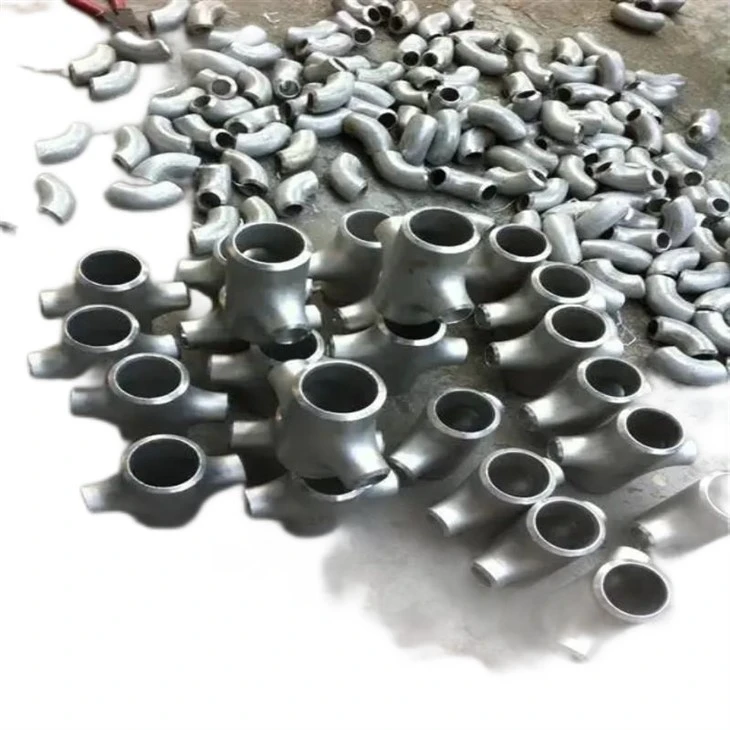
Butt Weld Equal Cross is a more complex fitting. It has four openings, and all of them need to be measured accurately. The dimensions of each opening should be consistent to ensure proper flow and connection. Measuring the center - to - center distances between the openings is also crucial for correct installation.
Quality Control and Verification
Once you've taken all the measurements, it's important to double - check them. You can use a different measuring tool to verify the readings. If you're dealing with a large order of pipe fittings, it's a good idea to measure a sample of them to ensure consistency across the batch.
If you find any discrepancies in the measurements, don't ignore them. Contact the manufacturer or supplier right away to discuss the issue. Sometimes, a small adjustment or replacement can save you a lot of headaches down the road.
Conclusion
Accurately measuring the size of butt welding pipe fittings is not just a technical requirement; it's a necessity for a successful pipeline project. From diameter and wall thickness to length and special dimensions for different fittings, every measurement matters.

As a supplier, I understand the importance of providing high - quality, accurately measured pipe fittings. If you're in the market for butt welding pipe fittings and need help with measurements or selection, I'm here to assist. Whether you're a contractor working on a large - scale project or a DIY enthusiast, getting the right fitting with the right measurements is crucial.
So, if you're looking for top - notch butt welding pipe fittings and reliable advice, don't hesitate to reach out. Let's discuss your project requirements, and I'll make sure you get the best - fitting products for the job.
References
- Pipe Fitting Handbook: A comprehensive guide on the standards and measurements of pipe fittings.
- Industry Best Practices for Pipeline Installation: Covers the importance of accurate measurements in ensuring a safe and efficient pipeline system.
Send Inquiry